How Mahalia Jackson Celebrated Christmas
The Significance of her Interpretation of “Silent Night”
When Mahalia Jackson celebrated Christmas, she did so just as she sang: with complete devotion, unbridled joy, and a deep, unshakable piety. For Mahalia, the holidays were far more than just a date on the calendar. They were a blend of a spiritual high mass, a culinary extravaganza, and the belated fulfillment of all those childhood dreams that had been denied her in her youth.
From a Cloth Doll to the Sea of Lights in Chicago
To understand Mahalia’s lavish Christmas celebrations, one must look to New Orleans, where she grew up in abject poverty with her strict Aunt Duke. Little Mahalia had never seen store-bought toys; she made her own dolls out of old scraps of fabric and grass. She only ever saw a decorated Christmas tree at church. There she would sit in awe, marveling at the lights and wishing with all her heart that the service would never end. Only in the kitchen did the sparkle of the holidays shine through once a year, when Aunt Duke would shut herself away for three days, letting no one in, and conjure up the most festive meal of the entire year.
When Mahalia moved into her own mansion on Indiana Avenue in Chicago decades later as a celebrated global superstar, she made up for everything she had missed as a child—and on an XXL scale.
During the Christmas season, her property was transformed into a spectacular wonderland: Colorful strings of lights wound their way through all the trees, a giant Santa Claus sat enthroned on the porch, and in the garden, a life-size nativity scene—complete with the Holy Family and the Three Wise Men—watched over the snow. The spectacle was so impressive that cars regularly blocked the street as onlookers stopped to marvel at the sea of lights. Mahalia herself would often sit quietly by the window at night, simply enjoying the sight of the sparkling colors.
"Cooking for Everyone"
Mahalia Jackson found loneliness during the holidays unbearable. Her home was open to everyone at Christmas—family, close friends, preachers, and fellow musicians.
The tables were piled high with Southern classics: several turkeys, ducks, Christmas ham, “State Street Chicken,” chitlins, and hearty leafy greens. On one occasion, their friend Missie even surprised the group with a whole, festively prepared suckling pig, complete with an apple in its mouth. Mahalia’s stated motto for the holidays summed it up perfectly: She wanted to “stuff every belly in sight—including her own.”
Faith Comes First—All the Way to Bethlehem
Amid all the culinary excess and glittering decorations, Mahalia never forgot whose birthday was actually being celebrated. For her, the religious significance of Christmas was unquestionably the top priority. So it was not uncommon for her to be standing at the altar of her home church, the Greater Salem Baptist Church in Chicago, as early as 4:00 a.m. on Christmas morning, proclaiming the good news to the congregation.
Two special Christmas celebrations in particular remain vivid in her memory and that of her companions:
– Christmas Eve in the Holy Land 1952
On her first major trip to Europe, Mahalia fulfilled a lifelong dream and traveled on to Bethlehem. There, at the birthplace of Jesus, she sang “Silent Night, Holy Night” on Christmas Eve.
– Return to New Orleans 1956
Shortly before the holiday, she packed her car to the brim with gifts for her nieces, nephews, and relatives and drove back to her old hometown. Her Assistant and Friend, the composer and music historian Bill Russell, surprised her there with a real Christmas tree. On Christmas Day, U.S. television broadcast live from her childhood church, Mt. Moriah, as she sang classics like “Sweet Little Jesus Boy” and “Born in Bethlehem”—before the entire extended family gathered at Aunt Duke’s for gumbo, turkey, and port wine.
Even in the final years of her life, when her health was already severely compromised, Mahalia Jackson refused to give up these traditions. Until the very end, she devoted all her energy to celebrating Christmas exactly as she loved to: in prayer, surrounded by the people she held dear, and at a richly set table.
The Significance of her Interpretation of “Silent Night”
"Silent Night" and Other Christmas Carols
Mahalia Jackson’s rendition of “Silent Night, Holy Night” and her Christmas recordings played a pivotal role in her career. They broke down language and racial barriers and introduced her to an audience of millions on both European and American radio and television.
1. The “Silent Night” Phenomenon
Musical Arrangement and the Original "Apollo" Version 1950
Mahalia first encountered the song as a traditional hymn from the *Baptist Standard Hymnal*. From a music-historical perspective, she performed it in what is known as “free triple meter.” In doing so, she broke away from a rigid meter, stretched out phrases, and took breaths in the middle of words to create space for her expressive vocal ornamentation. She recorded the original version on January 12, 1950, in New York for Apollo Records, accompanied by Herbert J. Francis on the organ and Mildred Falls on the piano. The solemn organ accompaniment allowed her to exercise her characteristic improvisational freedom.
The Breakthrough in Europe (1951–1952))
In the summer of 1951, Danish radio host John Jørgensen happened to play the Apollo recording during a jazz program, after which the radio station was flooded with calls. The label released the record in Denmark in 1952 under the title “Glade Jul.” Over 20,000 copies were sold almost immediately, and later even more than 50,000—making it the best-selling record in Denmark’s history up to that point. When Jackson traveled to Copenhagen in 1952, enthusiastic children scattered flowers on the steps of his hotel.
Christmas Eve in Bethlehem and the Move to Columbia
During her first trip to Europe in 1952, she also visited the Holy Land and sang “Silent Night” on Christmas Eve right inside the Church of the Nativity in Bethlehem. Shortly thereafter, jazz historian Marshall Stearns played her recording of “Silent Night” at the Music Inn in New York City for Columbia’s A&R director, Mitch Miller, as well as various radio producers. Miller was so impressed that he poached Mahalia from Apollo in 1954 and signed her to Columbia Records.
2. The Christmas albums and records
Over the course of her career, Mahalia Jackson recorded two major, full-length Christmas albums for Columbia Records, in addition to various singles and reissues.
Sweet Little Jesus Boy (Columbia CL 702 / CS 8759, 1955)
This album was recorded in New York in late May and early June 1955 under the direction of George Avakian, with the collaboration of composer and jazz scholar Bill Russell. Jackson was accompanied by the Falls-Jones Ensemble—featuring Mildre Falls on piano and Ralph Jones on organ—as well as, at times, a choir and a studio rhythm section that included, among others, Lionel Hampton on vibraphone. For the album cover, Mahalia posed in a white choir robe at her home church, following Avakian’s explicit instructions.
The album features a total of ten tracks
Silent Night, Holy Night in einer neuen Columbia-Einspielung, No Room at the Inn, O Little Town of Bethlehem, The Holy Babe (auch bekannt als Children, Go and I Will Send Thee), Joy to the World, O Come, All Ye Faithful sowie Go Tell It on the Mountain. Hinzu kommen Irving Berlins White Christmas, das Mahalia mit einem leichten, swingenden Jazz-Puls interpretierte, I Wonder as I Wander von John Jacob Niles und das 1934 von Robert MacGimsey komponierte Titelstück Sweet Little Jesus Boy.
Silent Night – Songs for Christmas (Columbia CL 1903 / CS 8703, 1962)
Her second major Christmas album was arranged with the collaboration of Percy Faith and Irving Townsend, featuring a significantly richer orchestral accompaniment and choirs. The track list once again combines classic Christmas carols with gospel elements and includes “Sweet Little Jesus Boy,” “A Star Stood Still,” “Hark, the Herald Angels Sing,” “Christmas Comes to Us All Once a Year,” “Joy to the World,” “O Come, All Ye Faithful,” “O Little Town of Bethlehem,” “What Can I Give” (written by Al Duckett’s sister), “Go Tell It on the Mountain,” and “Silent Night, Holy Night.”
3. Christmas on TV and Radio
Mahalia’s Christmas songs quickly became a regular tradition on American television and radio. She made her very first television appearance on Christmas Eve, December 24, 1951, on Studs Terkel’s local Chicago show, *Studs’ Place*. In December 1954, she also presented a grand holiday program on her own CBS radio show, *The Mahalia Jackson Show*, during the two Sunday broadcasts immediately preceding Christmas. On both episodes, she sang “Silent Night” alongside classics such as “Joy to the World,” “O Come, All Ye Faithful,” “Go Tell It on the Mountain,” “White Christmas,” and African American Christmas songs like “There Wasn’t No Room at the Inn.”
A special highlight was the legendary NBC homecoming as part of the show “Wide, Wide World“ on December 23 and 25, 1956. For the network program hosted by Dave Garroway, a television crew traveled to New Orleans to broadcast live on the Sunday before Christmas from her childhood church, Mt. Moriah Baptist Church. There, Mahalia sang “Sweet Little Jesus Boy” and sent the congregation into such a frenzy with a rousing rendition of “Born in Bethlehem” that the entire hall was dancing, and the TV director’s strict instruction to keep the hall quiet was completely forgotten.
In the late 1950s and 1960s, she went on to make numerous guest appearances on nationwide Christmas specials. These included an appearance on the Steve Allen Show—one of America’s most popular TV shows—during Christmas 1957, as well as regular invitations to the Bell Telephone Hour and the Dinah Shore Show, where she performed Christmas carols and hymns accompanied by large symphony orchestras or in duets.
© 2026 Thilo Plaesser
A Special Christmas Gift !
A one-of-a-kind book
Paperback / PDF
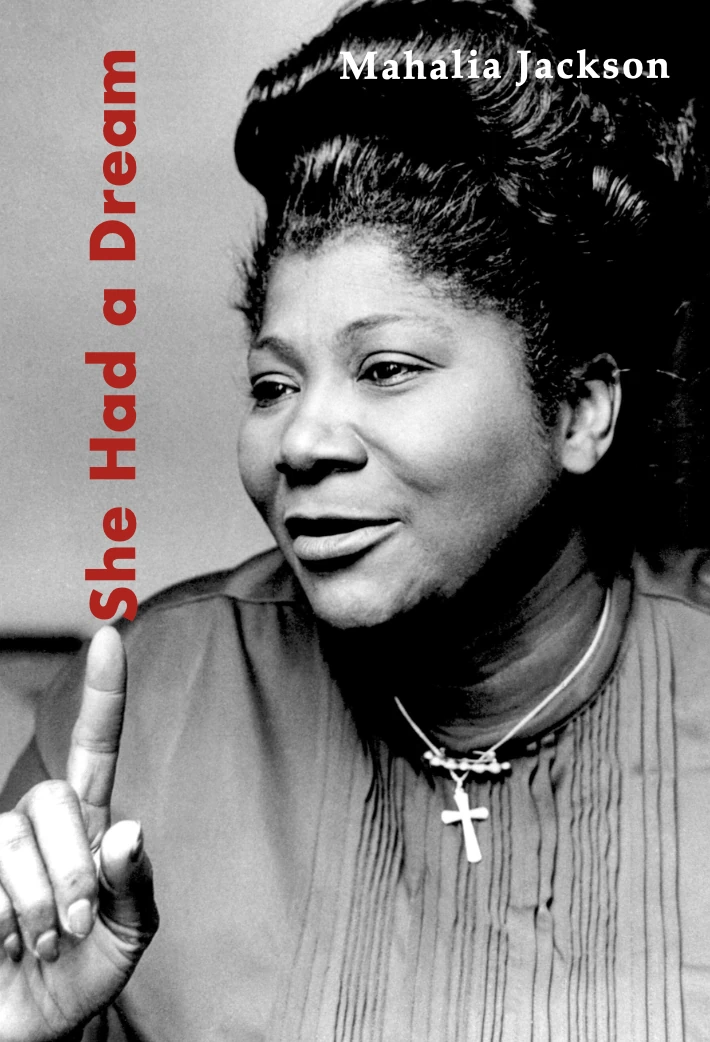
She Had a Dream
by Thilo Plaesser
248 pages, 20 photos
Coverfoto © AJ Pics / Alamy
ISBN: 978-3-98-286262-0
This book is not a conventional biography, but a journey to the heart of a legend—visionary, musically rich, and deeply inspiring. It offers a compelling glimpse into the human side of the icon.
Thilo Plaesser offers a knowledgeable and engaging analysis of the following aspects:
Mahalia as a performer, improviser, devout Christian, entrepreneur, and voice of the civil rights movement led by Dr. Martin Luther King. The book offers deep insights into Mahalia’s musical roots and the evolution of gospel music, and provides a well-founded understanding of what improvisation truly means. It sheds light on Mahalia’s unique vocal technique as well as the congenial musical connection she shared with her longtime pianist, Mildred Falls.
At the heart of the book is the principle of resilience.
In a time of global upheaval, Mahalia’s journey serves as a radical guide to self-assertion. Her life serves as a modern guide for the soul and demonstrates how a powerful course of action springs from an inner attitude. Exclusive forewords by her grandniece Valerie Nero, her stepdaughter Sigma Galloway, and her last organist, Dr. Charles Clency, attest to the authenticity of this book. As companions on her journey, they recommend this work as an authoritative bridge to the present, in which Mahalia’s legacy is more important than ever.
Paperback US $24.88 Order HERE
PDF Edition: US$16.95. Order HERE
Sustainable – Available Now
Also available in a German-language edition