A transatlantic romance
Mahalia Jackson frequently traveled on the SS United States. Less well known is her deep connection to this legendary passenger ship that crossed the Atlantic in the 1950s and 60s. For Mahalia, the ship was more than just a means of transportation; it was a place of peace, healing, and overcoming fears.

© Classic Stock/Alamy. The SS United States leaving New York Harbor in the 1950s

© Bettmann Archive Collection
Original Tickets from 1952
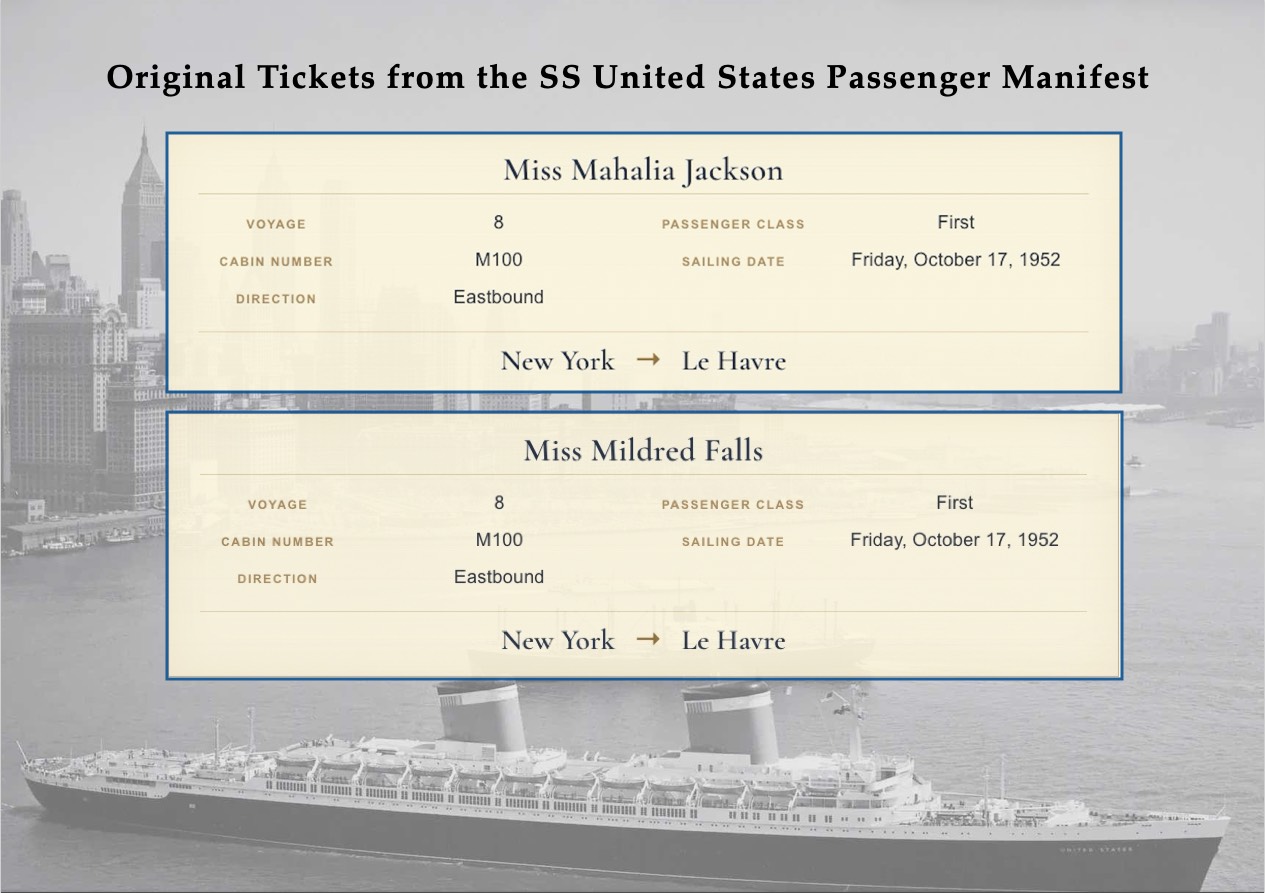
A journey with obstacles
Mahalia's relationship with the "big ship" began with a wish that did not always come true. Her fear of flying was well known, and so it was her dearest wish to take the SS United States for her first European tour in 1952. However, a sudden bout of sarcoidosis made it necessary for her to arrive in France quickly, and so she had to overcome her fear and board the plane after all.
Other opportunities, such as a planned wedding (and honeymoon) with Reverend Russell Roberts, also fell through. Although the SS United States was an option, the trip had to be postponed because she was scheduled to shoot a film in Hollywood.
The longing for the sea
Her longing for the sea voyage remained. Mahalia Jackson, who signed a contract in the 1960s stating that she would no longer fly, explicitly planned her 1961 European tour with the SS United States. Her road manager, David Haber, arranged for every comfort on board – from fruit and chocolate to champagne. The farewell at the port of New York was a spectacle: confetti and paper garlands flew, a band played. It was a symbolic farewell to fast but frightening air travel and a welcome aboard the cozy, seafaring past.
Healing on the open sea
The voyages on the SS United States were also a time of personal regeneration for Mahalia Jackson. During a crossing in the early 1960s, she was exhausted from her strenuous tour and suffering from seasickness. She spent most of her time in her cabin, praying and finding comfort in watching the peaceful sea. A ship's doctor prescribed a surprising cure: steaks, spinach, grapes, and a glass of wine with every meal. This unusual diet and her prayers worked. By the time she arrived in England, she was feeling better, stronger, and ready for her next concerts.
Their arrival in Europe was equally impressive. In Le Havre, France, their companion Mildred Falls was greeted by a representative of the Hot Club de France with a huge bouquet of flowers, while photographers captured the event. From here, Mahalia Jackson continued her tour, which even took her to the Holy Land – a journey that was continued by other means of transport, however. Mildred Falls mentioned in a 1972 interview that she would "never forget" the United States.
Even though the SS United States was not always her ship of choice, it was a constant companion in her plans and dreams. And when she sailed "home" after a grueling tour, she did so aboard her beloved ocean liner. The story of Mahalia Jackson and the SS United States is the story of an artist who, even in the age of jet travel, trusted in the slow but healing journey across the sea—and enjoyed it to the fullest.
Mahalia in her own words
New York, March, 30
“We took a cab to the United States Lines pier on W. 46th Street to board the SS United States. Loads of friends gathered to see me off. Everything was most exciting, with photographers from New York papers snapping pictures. I was dead tired and soon as the boat pulled out I was in my room and in bed.”
SS United States, April 1
“After sleeping for two days I came out of my stateroom through the insistence of musical director Meyer Davis who kept calling to me to attend a party for comedian Jackie Gleason. So finally I pulled myself out of bed and mingled with the guests, but within an hour I was back in my room looking out through the window at the beautiful water. I never knew water had such a drawing power on me. It was quite interesting to see the different forms and shapes the water would take, the different waves and colours; the different moods and sounds.”


Mahalia Jackson aboard the SS United States in January 1961
© Bettmann Archive Collection
A ship with two faces
The construction of the SS United States was more than just the design of a luxury liner. The US government subsidized the $78 million project with a clear goal: the ship had to be able to be converted into a troop transport for 15,000 soldiers within 48 hours if necessary. But in peacetime, it was to carry passengers across the Atlantic in unparalleled style.
The "Big U" made history on its maiden voyage in 1952. It crossed the North Atlantic in just 3 days, 10 hours, and 40 minutes, winning the prestigious "Blue Riband." It still holds this record today. The S.S. United States subsequently crossed the Atlantic 800 times! Designed by visionary engineer William Francis Gibbs, fire safety was a top priority. There was almost no combustible material on board – even the precious Steinway grand pianos were made of fireproof mahogany. No wonder celebrities and heads of state such as Marilyn Monroe, Marlon Brando, and US presidents Truman and Eisenhower felt at home on board.
The decline of an era
With the advent of the jet age in the 1960s, transatlantic cruises quickly lost their appeal. The SS United States was decommissioned in 1969 and began a long, sad journey through various ports. The ship changed hands several times and fell into disrepair. In the 1990s, it was partially gutted and stripped of asbestos in Ukraine, but plans to restore it repeatedly failed. The "Big U" lay in Philadelphia for almost 30 years, a rusting monument to past greatness.
Farewell to a Legend
On November 11, 2026, an era of seafaring came to a definitive end. Off the coast of Florida, in the Gulf of Mexico, the SS United States sank in a controlled manner to the ocean floor—exactly 74 years after it had been commissioned in 1952 as a technical masterpiece of its time.
Her legendary triumph on her maiden voyage in July 1952 remains unforgettable: Traveling at an average speed of over 35 knots, she claimed the “Blue Riband” for the fastest transatlantic crossing—a record for passenger ships that remains unbroken to this day. For decades after she was decommissioned in 1969, the once-proud flagship lay at anchor in Philadelphia, while enthusiasts and historians fought in vain to save her as a floating museum.
In 2025, her final chapter finally began when she was towed from Philadelphia to Mobile, Alabama, and meticulously prepared for her new purpose. With her sinking on November 11, the former ocean giant was transformed into the world’s largest artificial reef.
Although the ship could not be preserved as a monument above water, it serves a new, perhaps even more important purpose below the surface: This ambitious project is creating a valuable underwater ecosystem and offering divers and fishermen a unique new attraction. The SS United States is thus not only becoming a thriving home for corals and marine life, but also remains, deep beneath the surface, a lasting reminder of that golden era when ocean giants ruled the world’s seas—and she was the fastest of them all.
©Thilo Plaesser